1) Ammonium ion(NH4+) range:0.02~18000mg/L.
2) Chemical formula:F-,Cl-,Ca2+,NO3-,NH4+,K+,NH3,Mg2+,
Br−,Pb2+,Cu2+,CO2,NO2-, Cd,Ag+,I2, SCN-,CLO4-,BF4-,Li+etc
3) Online measure ion value and temperature at same time.
4) Directly with standard RS485 Modbus
5) Protection:IP68 and with waterproof cable
6) Ion membrane can be replaced to save cost.
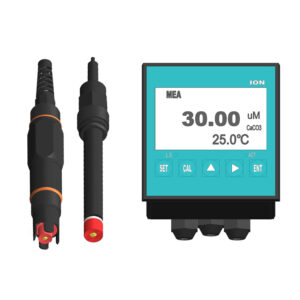
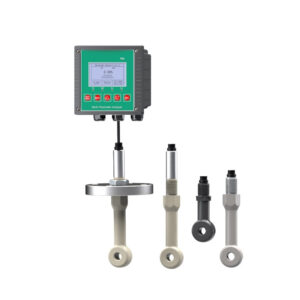
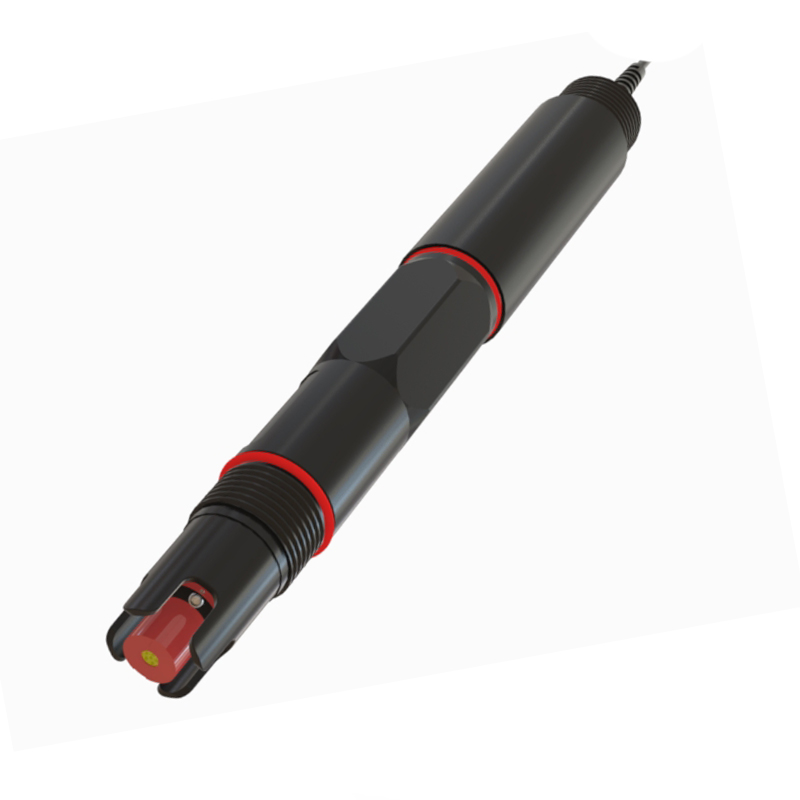
AM-IOT-ION is a digital ion sensor with standard RS485 Modbus communication,it’s developed by Aumeascon. Housing material is corrosion-resistant (PPS+POM), IP68 protection, suitable for most water quality monitoring environments;This online ion sensor uses an industrial-grade composite electrode, the reference electrode double salt bridge design and have longer working life;Built-in temperature sensor and compensation algorithm, high precision; It has been widely used in domestic and foreign scientific research institutions, chemical production, agricultural fertilizer, and organic wastewater industries. It is used for the detection of general sewage, waste water and surface water. It can be installed in sink or flow tank.
1) Ion membrane can be replaced and save cost.
2) Online ion measurement and temperature at same time.
3) With standard RS485 Modbus.
4) IP68 protection and water proof cable.
5) Special technology for harsh environments.
6) High accuracy , reliability and Quick response time
Model | AM-IOT-ION Digital Ion Sensor |
Ions type | F–,Cl–,Ca2+,NO3–,NH4+,K+,NH3,CO2,Mg 2+ , etc. |
Range | See below sensor table |
Power | 12V (customized for 5V,24VDC) |
Slope | Monovalent Ion 52~59mV and Divalent Ion22~29mv (25℃) |
Accuracy | <±2% 25℃ |
Response time | <60s (90% right value) |
Communication | Standard RS485 Modbus |
Temperature compensation | PT1000 |
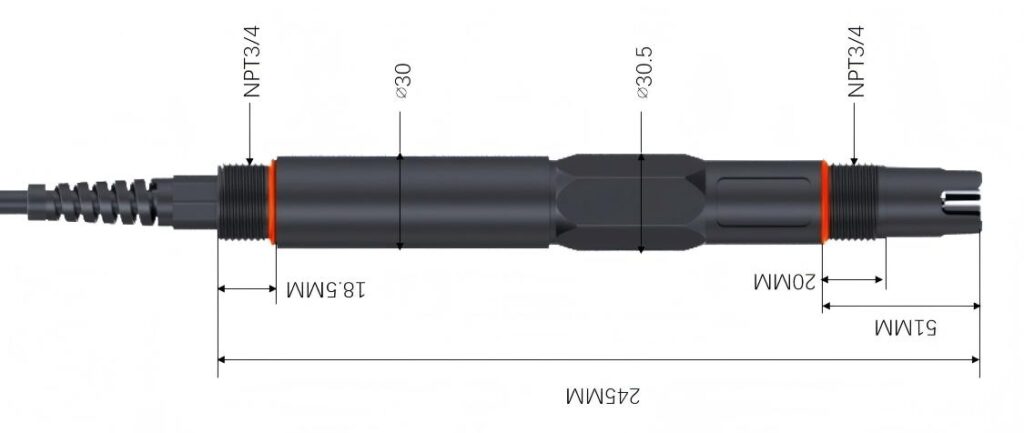
Dimension | D:30mm * L:250mm |
Cable length | Standard cable:5meters(it can be extended) |
(Table 1)
Ion | Formula | Membrane | Range @25℃ (mg/L) | pHRange | Temp.Range | WorkingPressure | Reference Ion |
Potassium ion | K+ | PVC | 0.04~ 39000 | 2-12 | 0~40 | 0-1Bar | Cs+,NH4+ |
Ammonium ion | NH4+ | PVC | 0.02~ 18000 | 4-10 | 0~40 | 0-1Bar | K+ |
Calcium ion (Water Hardness) | Ca2+ | PVC | 0.02~ 40000 | 2.5~11.5 | 0~40 | 0-1Bar | Pb2+,Hg2+,Fe2+, Cu2+,Ni2+ |
Magnesium ion | Mg2+ | PVC | 0.1~24000ppm | 3-10 | 0~40 | 0-1Bar | Ca2+, Cu2+, Pb2+, Hg2+, Ni2+ |
Nitrite | NO2– | PVC | 0.05~460 | 4-9 | 0~40 | 0-1Bar | NO3-, Cl- (need compensation) |
Nitrate | NO3– | PVC | 0.4 ~63000 | 2-12 | 0~40 | 0-1Bar | CIO4-,I-,CIO3-,F- |
Fluoride ion | F– | Solid | 0.02~saturation | 5-8 | 0~80 | 0-3Bar | OH- |
Chloride | Cl– | Solid | 1.8 ~35500 | 2-12 | 0~80 | 0-3Bar | CN-,Br,I-,S2- |
Ammonia | NH3 | PTFE | 0.02~ 17000 | >11 | 0~50 | 0-1Bar | Few, volatile amines |
Carbon dioxide (carbonate) | CO2 | PTFE | 4.4 ~ 440 | 4.8-5.2 | 0~50 | 0-1Bar | Volatile weak acid |
Bromide ion | Br− | Solid | 0.4~79900 | 2-14 | 0~80 | 0-3Bar | S2-,I-, CN- |
Iodide ion | I2 | Solid | 0.006~126900 | 0-14 | 0~80 | 0-3Bar | S2-,Br-,CN-,Cl-,S2O3-,NH3 |
Copper ions | Cu 2+ | Solid | 0.0064~ 6350 | 2-6 | 0-80 | 0-3Bar | Hg2+,Ag+,Fe2+,Br-,Cl- |
Lead ions | Pb2+ | Solid | 0.2~20700 | 3-8 | 0-80 | 0-3Bar | Ag+, Hg2+, Cu2+ |
Cadmium ions | Cd | Solid | 0.01~11200 | 2-12 | 0-80 | 0-3Bar | Ag+,Hg2+,Cu2+,Pb2+,Fe2+ |
Silver ions | Ag + | Solid | 0.01~107900 | 2-8 | 0-80 | 0-3Bar | Hg+,Hg2+,Cl- |
Thiocyanate | SCN- | Solid | 0.2~58100 | 2-10 | 0-80 | 0-3Bar | S2-,Br-,CN-,Cl-,S2O3-,NH3 |
Sodiuim ion | Na+ | Glass | 0.0~23000 | 5-12 | 0-80 | 0-3Bar | K+,H+ |
Barium ion | Ba2+ | PVC | 0.005~137000 | 2-12 | 0-40 | 0-1Bar | No obvious interference |
Lithium ion | Li+ | PVC | 0.007~6941 | 2-9 | 0-40 | 0-1Bar | Cs+, K+ |
Surfactants |
| PVC | Determined by ingredients | 2-12 | 0-40 | 0-1Bar | Similar cationic and anionic surfactants |
Tetrafluoroborate | BF4- | PVC | 0.5~10800 | 2.5-11 | 0-40 | 0-1Bar | ClO4-, I-, CN- |
Perchlorate | CLO4- | PVC | 0.7~99000 | 2.5-11 | 0-40 | 0-1Bar | No obvious interference |
Cyanide ion | CN- | Solid | 0.13~260 | 11-13 | 0-80 | 0-3Bar | S2-, I-, CN-, Cl- |
Sulfide ion | S2- | Solid | 0.003~32100 | >11 | 0-80 | 0-3Bar | Hg2+, Cl- |
1) Electrode wiring (ION/GLASS: working electrode connected to transparent wire, REF: reference electrode connected to shielded mesh wire, SG: solution ground connected to green wire, TEMP: temperature electrode connected to black and white wire, no positive or negative);
2) Wire extension: When the customer extends or modifies the cable by himself, it is necessary to ensure that the black conductive rubber of the shielded wire core is peeled off and the transparent core is leaked;(Otherwise, the working electrode and the reference electrode are in a short-circuit.
1) Connect the electrode with the computer through the 485 interface, and connect the power supply to the electrode as required
2) View the mV value of the sensor via Modbus software
3) Write the number “0” into the “1st calibration point target value” register(0x0024) ,”2nd calibration point target value” register (0x0026),”3rd calibration point target value” register(0x0028) ,”4th calibration point target value” register (0x002A), see the holding register list for the register address.
4) Rinse the electrode with pure water, dry the water with a paper towel, put the electrode into the 10 standard solution, turn on the magnetic stirrer and stir evenly at a constant speed, and wait for about 8 minutes for the data to stabilize (so-called stable: potential jump ≤ 0.5mV/min) , Record the value (E1), and write the standard solution concentration “10” into the digital electrode “1st calibration point target value” register(0x0024) through the Modbus software, the register address sees the holding register list;
5) Rinse the electrode with pure water, absorb the water with a paper towel, put the electrode into the 100 standard solution, turn on the magnetic stirrer and stir evenly at a constant speed, and wait for about 8 minutes for the data to stabilize (so-called stable: potential jump ≤ 0.5mV/min) , record the value (E2), and write the standard solution concentration “100” into the digital electrode “target value of the second calibration point” register(0x0026) through the Modbus software, the register address sees the holding register list; when the value of the second calibration point is written into the digital electrode After the corresponding register is set, the calibration is completed.
6) The difference between the two values (E2-E1) is the slope of the electrode.
7 )Monovalent Ion:52~59mV@25℃ : NH4+, K+, NO3-, Cl-, F-, NH3, CO2.
8) Divalent Ion: 22~29mV@25℃ : Ca2+, Mg2+
NO. | Application | Most customers measure below ions. |
1 | Agriculture | Nitrate, calcium, sodium, potassium, bromide, chloride, ammonia & fluoride |
2 | Plant Tissue | Nitrate, chloride, fluoride, iodide, cyanide, calcium, sodium and potassium |
3 | Fertilizer | Nitrate using the ammonia electrode, potassium and fluoride |
4 | Aquaculture | Ammonia, nitrate, calcium and dissolved oxygen |
5 | Biomedical Research | Calcium, carbon dioxide and ammonia |
6 | Education | Various ISEs electrodes are used in most colleges and niversities |
7 | Food Processing | Chlorides, nitrate, sodium and fluoride |
8 | Milk and Dairy Products | Chloride, calcium, fluoride, sodium and iodide |
9 | Soft Drinks | Chloride, fluoride, carbon dioxide and residual chlorine |
10 | Alcohol | Potassium, sodium, CO2, fluoride, bromide, calcium, and residual chlorine |
11 | Vegetables | Nitrate, chloride and sodium |
12 | Geology and Mining | Fluoride, calcium and cyanide |
13 | Metallurgy and Metal Plating | Fluoride, cupric, cyanide, fluoroborate and nitrate |
14 | Plating Baths | Chloride, residual chlorine and ammonia |
15 | Pulp and Paper | Sodium, chloride, calcium and sulfate |
16 | Petroleum Refining | Ammonia andchloride |
17 | Pharmaceuticals | Fluoride and soldium |
18 | Sewage Treatment | Nitrate, ammonia, residual chlorine and dissolved oxygen (BOD) |
19 | Steam and Power Generation | Chloride, sodium, residual chlorine, fluoroborate and dissolved oxygen |
20 | Drinking Water | Total, free & residual chlorine, nitrate, calcium, chloride, and fluoride |
21 | Natural Water | Bromide, calcium, chloride, fluoride, nitrate, potassium, silver, sodium & cupric |
22 | Sea Water | Sodium, chloride, fluoride, nitrate and ammonia |
We will contact you within 1 working day, please pay attention to the email with the suffix “@aumeascon.com”.