
Pressure (Hydrostatic)
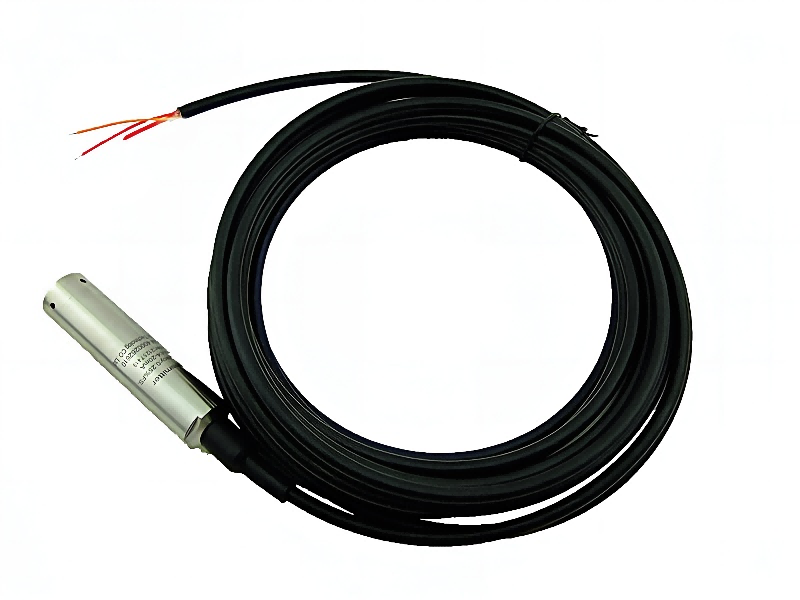
AM-P200 Submersible Level Transmitter
Submersible hydrostatic level transmitter, 0–200 m, 0.2 or 0.5 % FS, 4–20 mA and RS485, IP68 sensor on a vented cable.
- Model
- AM-P200
- Category
- Pressure (Hydrostatic)
- Outputs
- 4–20 mA, RS485
- Lead time
- 7–10 working days for standard
- MOQ
-
1 pc
10 pcs for OEM - OEM available
- Yes
A submersible transmitter does one thing well: it turns the weight of the liquid above it into a current. There is no beam for foam to interrupt, no blind zone to sit inside, nothing above the water line to clean — which is why it is the default level instrument in a wet well, a sump or a borehole.
The price is that it lives in the medium. The diaphragm has to survive it, the cable has to stay vented to atmosphere or the reading follows the barometer instead of the water, and the range has to be chosen for the depth you actually have. The P201 is the same transmitter with an LCD on the housing; the datasheet’s comparison table leaves every other row blank, so beyond the display treat the two as one instrument until we confirm otherwise.
Technical specifications
| Measuring principle | Hydrostatic: a piezo-resistive silicon cell reads the head of liquid above the diaphragm, with the cable vented to atmosphere |
|---|---|
| Range | 0–200 m |
| Accuracy | 0.2 % FS or 0.5 % FS |
| Output | 4–20 mA |
| Communication | RS485 |
| Medium | Water, fuel, oil and other liquids compatible with silicon and stainless steel |
| Operating temperature | −40 to +80 °C |
| Overpressure | 150 % FS |
| Long-term stability | ≤ ±0.2 % FS per year |
| Sensor material | SS304, SS316L or PTFE |
| Cable | Vented, for automatic barometric compensation |
| Protection | IP68, sensor |
| Display | P200: none. P201: LCD |
Every value above is on the datasheet: AM-P200 and AM-P201 Submersible Level Transmitter Datasheet (PDF · 262.3 KB)
What it is not the answer for
Read this before asking for a price: one of these conditions is what turns a good meter into a bad installation.
- Media that attack the diaphragm: the datasheet requires liquids compatible with silicon and stainless steel, with SS304, SS316L or PTFE the only choices named
- Any pressure above 150 % FS: the manual states the maximum in the measuring system must not exceed the rated overload
- A tank under vacuum, or a sealed vapour space — the vented cable has to see atmosphere to give a level
- A depth where 0.5 % FS is already too much error: accuracy is a percentage of full scale, so an oversized range is an oversized error — take the 0.2 % variant or a narrower range
- A site that needs a local display on the standard build: that is the P201, and the datasheet shows no other difference
- A wet well full of rags, or anyone likely to poke the flush diaphragm — the manual forbids touching it and putting hard or sharp objects in the pressure port
A medium that attacks the diaphragm, or a tank that cannot be vented to atmosphere? Then hydrostatic pressure is the wrong principle — the ultrasonic or radar meter reads the surface without touching the medium.
Maintenance and service life
Lift it and clean the diaphragm on an interval the medium sets, not the calendar: grease and rags in sewage, silt in river and reservoir service. Re-check the zero in air after cleaning. Keep the vent tube open and dry — that is the single most common cause of a level reading that drifts with the weather. On insulation checks the manual limits the circuit to 45 V and forbids a 100 V megger.
Behind the instrument
How it is built and tested
Coil winding, the calibration bench, the plant floor — and an overseas customer's factory audit.
What buyers ask before ordering
- Which accuracy will I actually get?
- 0.2 % or 0.5 % of full scale — and the datasheet prints both in one cell without saying which belongs to which variant. Say the figure your process needs and we confirm it on the order rather than assume the better one.
- Why does the cable have a vent tube?
- It reads the head of liquid above the diaphragm, so the vented cable is not an accessory: it keeps the reference at atmospheric pressure. Pinch it, block it or let it fill with water and the reading starts tracking the weather.
- What happens on a pressure surge?
- The datasheet states 150 % FS as the overload, and the manual adds that the maximum pressure in the measuring system must not exceed it. A surge in a wet well or a pump start is exactly what breaks this rule, so say if the site does that.
- P200 or P201?
- The datasheet only differentiates the display: P200 has none, P201 has an LCD. Every other row of its comparison table is blank for the P201, so treat the rest as identical until we confirm — and choose the P201 only if you need to read the level at the well head.
- Which material for sewage or seawater?
- The diaphragm: SS304, SS316L or PTFE, and the medium must be compatible with silicon and stainless steel. The manual is explicit that the flush diaphragm must not be touched or poked, and that no hard or sharp object belongs in the pressure port.
- What do you need from me to quote?
- The range and the medium, the depth you actually work at (accuracy is % of full scale, so an oversized range is an oversized error), the thread you need — the datasheet does not state one — and whether you want the local display. The form on this page asks for exactly that.
Still not sure which version fits your line? Send the medium and the process conditions — we answer with the configuration, not a catalogue.
Applications
Where this model is used
Each application names a measuring point and the conditions that decide the selection.
WW-PS
Pump Station Wet Well Level and Pressure
Wet well level control and rising main pressure for sewage pump stations, where foam and grease blind a non-contact sensor.
WW-WD
Water Distribution District Metering
District metering and pressure management for distribution networks, where night flow and peak demand differ by an order of magnitude.
Elsewhere in the range
Other models in Pressure (Hydrostatic)
The same category holds the models that solve the neighbouring problem, and the price difference is usually smaller than the cost of the wrong principle.
Measuring point does not match the table above?
Send the medium, the pipe size and the output your control system expects. We answer with the principle that fits, or with the reason none of ours does.