
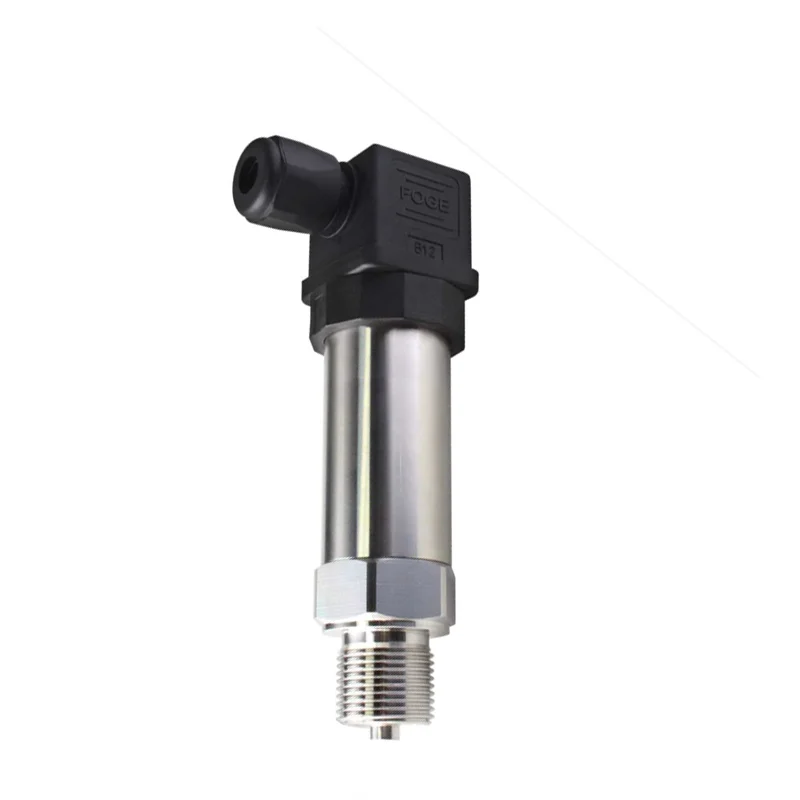
Pressure Transmitter
AM-P100 Pressure Sensor
Diffused-silicon pressure transmitter, −0.1 to 100 MPa at 0.25 % FS, 316L diaphragm, 4–20 mA or RS485, IP65.
- Model
- AM-P100
- Category
- Pressure Transmitter
- Outputs
- 4–20 mA, RS485
- Lead time
- 7–10 working days for standard
- MOQ
-
1 pc
10 pcs for OEM - OEM available
- Yes
A pressure transmitter is the simplest instrument on the site and the one most often bought on price. This one is a diffused-silicon cell in a stainless body: 0.25 % FS, ≤0.1 % a year of stability, and a 316L isolation diaphragm between the medium and the silicon, with the range built to order anywhere from −0.1 MPa of vacuum to 100 MPa.
The choice is three letters rather than fifteen: how it connects (Hirschmann, M12 or cable), what it sends (4–20 mA, RS485, 0–5 V or 0–10 V), and which thread you already have (G1/2, G1/4 or M20×1.5). What the datasheet does not decide for you is the range — and the range is what turns 0.25 % FS into either a useful number or a large one.
Technical specifications
| Measuring principle | Diffused-silicon piezo-resistive cell behind an oil-filled 316L isolation diaphragm |
|---|---|
| Measuring range | −0.1 to 0 MPa through to 0–100 MPa, compound and multi-span; the range is built to order |
| Pressure types | Gauge, absolute, sealed gauge |
| Accuracy | 0.25 % FS |
| Long-term stability | ≤ 0.1 % per year |
| Overload | 150 % FS |
| Supply voltage | 12–30 V DC |
| Output | 4–20 mA, RS485, 0–5 V or 0–10 V |
| Medium temperature | −40 to +150 °C |
| Operating temperature | −30 to +80 °C |
| Relative humidity | 0–90 % |
| Wetted diaphragm | 316L stainless steel |
| Process connection | G1/2, G1/4, M20×1.5 |
| Electrical connection | Hirschmann (H), M12 (M) or cable (Z) |
| Protection | IP65 |
Every value above is on the datasheet: AM-P100 Pressure Sensor Datasheet (PDF · 266.9 KB)
What it is not the answer for
Read this before asking for a price: one of these conditions is what turns a good meter into a bad installation.
- Media that attack 316L: the datasheet names no other wetted material and no Hastelloy or ceramic option, so a diaphragm seal or another instrument is the answer
- Media above 150 °C, or an ambient above 80 °C: the datasheet offers no heat isolation, and the electronics are rated −30 to +80 °C
- Pressure spikes well past 150 % FS: there is no snubber in the datasheet
- A measurement at the bottom of an oversized span: 0.25 % FS of a far-too-wide range is a large absolute error — size the range for the working pressure
- A hazardous area: the datasheet lists no explosion-proof approval
- A HART loop: this datasheet offers 4–20 mA, RS485, 0–5 V and 0–10 V, not HART
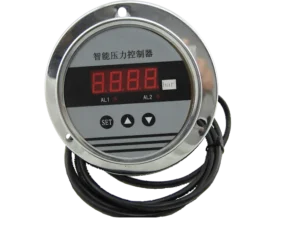
Need a switch contact rather than a signal — a pump cut-out, a high-pressure alarm? A transmitter only transmits: the pressure controller carries the setpoints and the relay, and it is a different purchase.
Maintenance and service life
Check the zero against atmosphere once a year, and clean the diaphragm if the medium can deposit on it — a crystallising liquid will seal the port first. The seal and the diaphragm are the parts that fail. In pump-station duty fit a snubber or a damping restrictor rather than buying a wider range: an oversized range is how a surge hides from the operator.
Behind the instrument
How it is built and tested
Coil winding, the calibration bench, the plant floor — and an overseas customer's factory audit.
What buyers ask before ordering
- Is 0.25 % good enough?
- 0.25 % of full scale, with ≤0.1 % a year of stability. Because it is % of full scale, a 100 MPa transmitter asked to watch 4 MPa is only good to 0.25 MPa — choose the range for the pressure you work at, not for the highest you can imagine.
- Will it survive a pressure spike?
- No. The datasheet gives 150 % FS as the overload and offers no snubber; a pump start or a valve closing sends far more than that for a millisecond. Fit a damping restrictor or a snubber at the tapping, which is cheaper than the larger range that would hide the surge.
- Can it take seawater or a chemical?
- The datasheet lists 316L for the isolation diaphragm and no other wetted material, so aggressive media need a diaphragm seal or a different instrument. Ask before you buy rather than after the diaphragm has been eaten.
- Which output do I order?
- 4–20 mA for an analogue card, RS485 where the PLC polls registers, or 0–5 V / 0–10 V for a controller that wants volts. There is no HART option in this datasheet — if the loop is already HART, say so and we will quote the model that has it.
- What do H, M and Z mean?
- Hirschmann, M12 or a fixed cable — that is the H, M and Z in the code — with G1/2, G1/4 or M20×1.5 for the process side. The three letters are the whole configuration apart from the range.
- What do you need from me to quote?
- The pressure range and whether it is gauge, absolute or sealed, the medium and its temperature, the thread you have, the output your control system reads, and whether the site is a hazardous area — because this datasheet lists no Ex approval. The form on this page asks for exactly that.
Still not sure which version fits your line? Send the medium and the process conditions — we answer with the configuration, not a catalogue.
Applications
Where this model is used
Each application names a measuring point and the conditions that decide the selection.
WW-PS
Pump Station Wet Well Level and Pressure
Wet well level control and rising main pressure for sewage pump stations, where foam and grease blind a non-contact sensor.
WW-WD
Water Distribution District Metering
District metering and pressure management for distribution networks, where night flow and peak demand differ by an order of magnitude.
Elsewhere in the range
Other models in Pressure
The same category holds the models that solve the neighbouring problem, and the price difference is usually smaller than the cost of the wrong principle.
Measuring point does not match the table above?
Send the medium, the pipe size and the output your control system expects. We answer with the principle that fits, or with the reason none of ours does.