
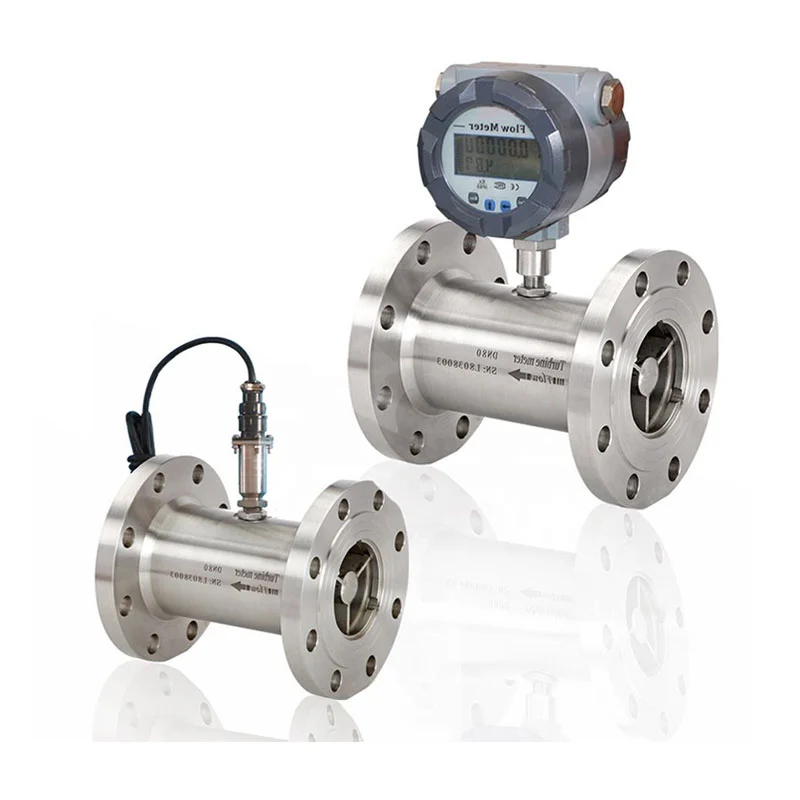
Turbine
AM-LTF Liquid Turbine Flow Meter
Liquid turbine flow meter for clean, non-abrasive liquids: DN4–DN200, ±0.5 % of reading (±0.2 % on the accurate build), pulse, 4–20 mA, RS485.
- Model
- AM-LTF
- Category
- Turbine
- Outputs
- Pulse, 4–20 mA, RS485, HART
- Lead time
- 7–10 working days for standard
- MOQ
-
1 pc
10 pcs for OEM - OEM available
- Yes
A turbine meter is a rotor in the flow, and everything good and bad about it follows from that. The rotor turns at a speed proportional to velocity, the pulses are counted, and the K-factor printed for that individual meter turns pulses into litres. That is why it belongs on batch lines, fuel metering and clean process water, where the liquid is known and the profile is calm.
Nothing about it is forgiving. The liquid must not erode the rotor or carry fibre and granules, the bearing wears on throughput rather than on years, and the strainer in front of it is part of the instrument. In exchange you get ±0.5 % of reading — or ±0.2 % on the high-accuracy build — from DN4 upwards, at sizes and prices where no other principle reaches the same figure.
Technical specifications
| Measuring principle | Rotor driven by the flow: pulse frequency follows velocity, and the meter's own K-factor converts pulses to volume |
|---|---|
| Line size | DN4–DN200 (DN250 and DN300 in the dimension table) |
| Accuracy | ±0.5 % of reading, or ±0.2 % of reading on the high-accuracy build |
| Medium | Liquid that does not erode stainless steel, 2Cr13, Al2O3 or hard alloy, and is free of fibre and granules |
| Medium temperature | −20 to +120 °C standard; −20 to +70 °C on the explosion-proof build |
| Pressure rating | By flange code: PN10/16/25/40, ANSI 150#/300#/600#, JIS 10K/20K/30K |
| Body and wetted parts | SS304 or SS316L body, 2Cr13 impeller, hard-alloy bearing |
| Process connection | Flange (DIN, ANSI, JIS), male or female thread, tri-clamp |
| Output | Pulse, 4–20 mA, alarm contact (optional) |
| Communication | RS485 Modbus, HART |
| Power supply | 24 V DC, or 3.6 V lithium battery |
| Protection | IP65; IP67 optional |
| Hazardous area | Ex d IIC T6 Gb |
| Structure and cable | Compact or remote; cable entry M20×1.5, 10 m cable standard, other lengths on request |
Every value above is on the datasheet: AM-LTF Liquid Turbine Flow Meter Datasheet (PDF · 303.4 KB)
What it is not the answer for
Read this before asking for a price: one of these conditions is what turns a good meter into a bad installation.
- Liquids carrying fibre, granules or anything abrasive: the datasheet requires a liquid that will not erode stainless steel, 2Cr13, Al2O3 or the hard-alloy bearing
- Explosion-proof builds above 70 °C: the Ex version is limited to −20 to +70 °C while the standard build reaches 120 °C
- Viscous liquids: the datasheet states no viscosity limit at all, so heavy oils and syrups need confirming — a positive-displacement or Coriolis meter is the safer answer
- Dirty service without a strainer upstream: the rotor and the bearing are the parts that wear
- A line that cannot hold a full, steady profile — a turbine meter reads the velocity passing its rotor, so swirl and pulsation show up straight away
Fibrous, abrasive or viscous liquid? Then a rotor in the flow is the wrong instrument — the electromagnetic meter has nothing in the path, and the Coriolis meter weighs the medium whatever its viscosity.
Maintenance and service life
The bearing is the consumable: replace it on throughput, not on the calendar, and expect it to be the first thing that changes the K-factor. Keep the upstream strainer in place and check it on a schedule — a single hard particle through the rotor costs a recalibration. Re-verify the K-factor after any bearing or rotor change, and keep the meter's own K-factor sheet with the installation record.
Behind the instrument
How it is built and tested
Coil winding, the calibration bench, the plant floor — and an overseas customer's factory audit.
What buyers ask before ordering
- Is it ±0.5 % or ±0.2 %?
- Two builds: ±0.5 % of reading as standard, or ±0.2 % of reading on the high-accuracy version. Both are stated as % of reading rather than of full scale, which matters at low flow — say which figure your process has to meet when you order.
- What flow range does a DN25 cover?
- The datasheet gives no per-size flow table and no viscosity limit — it says "wide measuring range, low flow velocity workable" and stops there. Send us the DN, the medium and its viscosity and we quote the flow band for that combination rather than a number that may not apply to your liquid.
- Will it handle diesel or fuel oil?
- Yes — the datasheet names tap water, demineralised water, chemicals, fuels, marine engine fuel, vegetable oil, thermal oil and solvents, with special versions for refrigerants, pharmaceutical fluids, cryogenic fluids and liquefied gases. The condition is always the same: clean, non-abrasive, no fibre or granules.
- How much straight pipe does it need?
- The datasheet gives neither straight-run lengths nor a mounting orientation, so they are specified on the order. In practice plan on about ten diameters upstream and five downstream, a strainer in front, and a full pipe at the rotor — and confirm with us before the pipe is cut.
- What outputs can I get?
- Pulse for a counter or totaliser, 4–20 mA for an analogue input, RS485 Modbus or HART where the PLC polls, and an optional alarm contact. The meter can run from 24 V DC or from its own 3.6 V lithium battery where no supply exists.
- What wears out, and when?
- The bearing, and it is a consumable: replace it on throughput, not on the calendar. The impeller itself survives unless something abrasive passes, and each meter's K-factor sheet is its calibration — keep it, because a replacement rotor changes the number.
Still not sure which version fits your line? Send the medium and the process conditions — we answer with the configuration, not a catalogue.
Applications
Where this model is used
Each application names a measuring point and the conditions that decide the selection.
WW-WD
Water Distribution District Metering
District metering and pressure management for distribution networks, where night flow and peak demand differ by an order of magnitude.
WW-IP
Industrial Process Measurement
Flow, level and water quality in chemical, food and pharmaceutical processes, where wetted materials and signal compatibility decide the choice.
Elsewhere in the range
Other models in Flow Measurement
The same category holds the models that solve the neighbouring problem, and the price difference is usually smaller than the cost of the wrong principle.
AM-CMFM
AM-CMFM Coriolis Mass Flow Meter
Coriolis mass flow meter that reads mass, density and temperature from one tube — DN1–DN150, for dosing and recipe lines.
AM-D-DFM
AM-D-DFM Doppler Flow Sensor
RS485 Doppler flow sensor, not a meter: 0.03–5 m/s velocity, 0.05–10 m level, 7.2–15 V DC, for a host to compute flow.
AM-DFM
AM-DFM Doppler Flow Meter
Doppler flow meter for channels, manholes and partly filled pipes: surface velocity plus water level, no weir or flume required.
Measuring point does not match the table above?
Send the medium, the pipe size and the output your control system expects. We answer with the principle that fits, or with the reason none of ours does.