
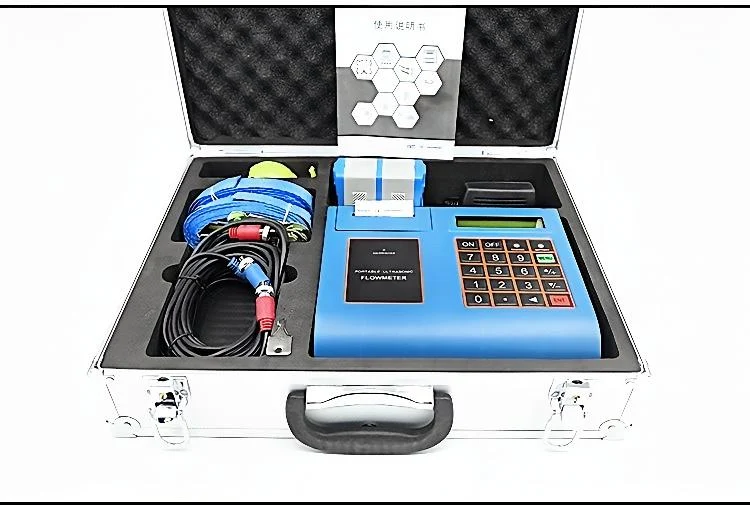
Clamp-on Ultrasonic
AM-ULF-P Portable Ultrasonic Flow Meter
Portable clamp-on ultrasonic flow meter for DN15–DN6000: 20-hour battery, built-in thermal printer, ±1 % of reading, RS485.
- Model
- AM-ULF-P
- Category
- Clamp-on Ultrasonic
- Outputs
- RS485
- Lead time
- 7–10 working days for standard
- MOQ
-
1 pc
10 pcs for OEM - OEM available
- Yes
A clamp-on ultrasonic meter reads the velocity of the liquid through the pipe wall: two transducers are pressed onto the outside of the pipe with couplant, the instrument measures how the sound behaves in the flowing stream, and no wetted part, no pressure drop and no pipe disturbance follows. The AM-ULF-P puts that pair in a high-strength case with a 20-hour Ni-MH pack, a 2-line backlit display, a 4×4+2 keypad and a built-in thermal printer.
Buy it for what a fixed meter cannot do: a survey across a dozen measuring points, a week of temporary metering during a shutdown, a check on a meter you already pay for, or a line you cannot cut. It is not your permanent instrument. Twenty hours of battery, an RS485 port and a thermal printer mean readings, not a control signal — the loop, the hazardous area and the year-round record belong to a fixed installation.
Technical specifications
| Measuring principle | Clamp-on ultrasonic: two transducers on the outside of the pipe, no wetted parts |
|---|---|
| Pipe size | DN15–DN6000 |
| Flow velocity | 0 to ±30 m/s |
| Accuracy | Better than ±1 % |
| Linearity | 0.5 % |
| Repeatability | 0.2 % |
| Liquids measured | Water, sea water, industrial sewage, acid and alkali liquid, oils — any liquid that transmits sound |
| Standard transducers | TS-1 for DN15–DN100, TM-1 for DN50–DN1000, TL-1 for DN300–DN6000; magnetic mount, liquid temperature ≤ 110 °C |
| High-temperature transducers | Tri-clamp TS-2-HT, TM-1-HT, TL-1-HT and rail HS-HT, HM-HT, EB-1-HT, −30 to +160 °C |
| Display | 2-line × 20-character LCD with backlight |
| Main unit temperature | −20 to +60 °C |
| Keypad | 4×4+2 push-button keypad |
| Printer | Built-in mini thermal printer, 24-character lines, instant and timed printing |
| Data logger | Built-in, with uplink to a computer or the internet |
| Interface | RS485 serial port |
| Power supply | Rechargeable Ni-MH battery for 20 hours of operation, or AC 220 V; intelligent charging stops automatically with a green indicator |
| Power consumption | 1.5 W |
| Carrying case | High-strength case for normal and harsh environments |
Every value above is on the datasheet: AM-ULF-P Portable Ultrasonic Flow Meter Datasheet (PDF · 216.9 KB)
What it is not the answer for
Read this before asking for a price: one of these conditions is what turns a good meter into a bad installation.
- A liquid that does not transmit sound: an aerated stream or one carrying heavy solids scatters the signal the transducers read through the wall
- A pipe wall the ultrasound cannot cross — lined, coated or heavily scaled pipe gives no reliable path from transducer to liquid
- A reading you need continuously and unattended: the Ni-MH pack gives 20 hours of operation, then the unit is charged from AC 220 V
- A control system that expects 4–20 mA, pulse or Modbus — the datasheet lists an RS485 port and a printer, no analog or pulse output
- A hazardous area: no explosion-proof approval appears in the datasheet
- A pipe you cannot couple to — buried, insulated or unreachable wall where the transducers cannot be pressed on with couplant
If the pipe is there to stay and the reading has to be continuous, a fixed installation does the same job without the battery: the AM-ULF-W clamps onto the same line and stays on it.
Maintenance and service life
Renew the couplant and wipe the transducer faces before every survey: a dry or dirty face loses signal strength long before it fails. Charge the Ni-MH pack after each use, since the unit is rated for 20 hours of operation, and keep the printer paper in the case. Check one reading against a known reference annually — the datasheet states linearity and repeatability as the factory figures, not a recertification interval.
Behind the instrument
How it is built and tested
Coil winding, the calibration bench, the plant floor — and an overseas customer's factory audit.
What buyers ask before ordering
- What pipe sizes can it clamp onto?
- DN15 to DN6000. The transducers come in three magnet-mounted sizes — TS-1 for DN15–DN100, TM-1 for DN50–DN1000 and TL-1 for DN300–DN6000 — so give us the outside diameter and the pair is chosen from that.
- Which liquids, and what liquid temperature?
- Water, sea water, industrial sewage, acid and alkali liquid and oils: any liquid that transmits sound. Standard transducers take liquid up to 110 °C, and the high-temperature tri-clamp and rail sets are rated −30 to +160 °C. A stream that is mostly air or heavy solids is the case to rule out first.
- Where does the ±1 % come from?
- The datasheet gives linearity 0.5 %, repeatability 0.2 % and accuracy better than ±1 % of reading. Those are the factory figures; on site the wall condition and the transducer spacing decide whether you see them, which is why we ask for pipe material and size before quoting.
- Does it log and print, and how do readings get out?
- There is a built-in data logger with uplink to a computer or the internet, a built-in mini thermal printer that prints instantly or on a timer, and an RS485 serial port. The datasheet lists no 4–20 mA, pulse or Modbus output, so RS485 is the route into your own system.
- How long does it run away from mains power?
- The built-in rechargeable Ni-MH battery is rated for 20 hours of operation, at 1.5 W consumption. Recharging is from AC 220 V, with an automatic stop and a green indicator when full — tell us if the site runs on 110 V, because AC 220 V is the one supply the datasheet fixes.
- What can it not measure?
- Anything that stops the sound reaching the liquid: a lined, coated or heavily scaled pipe wall, or a stream carrying a lot of air or solids. It also gives no permanent control signal and carries no hazardous-area approval. For those points the answer is another principle, not a bigger battery.
Still not sure which version fits your line? Send the medium and the process conditions — we answer with the configuration, not a catalogue.
Applications
Where this model is used
Each application names a measuring point and the conditions that decide the selection.
WW-WD
Water Distribution District Metering
District metering and pressure management for distribution networks, where night flow and peak demand differ by an order of magnitude.
WW-IP
Industrial Process Measurement
Flow, level and water quality in chemical, food and pharmaceutical processes, where wetted materials and signal compatibility decide the choice.
Elsewhere in the range
Other models in Clamp-on Ultrasonic
The same category holds the models that solve the neighbouring problem, and the price difference is usually smaller than the cost of the wrong principle.
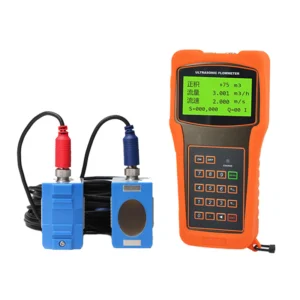
AM-ULF-H
AM-ULF-H Handheld Ultrasonic Flow Meter
Handheld clamp-on ultrasonic flow meter for DN15–DN6000: ±1 % of reading, 2000-line logger, RS-232, over 12 hours per charge.
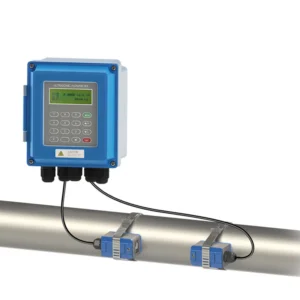
AM-ULF-W
AM-ULF-W Wall Mounted Ultrasonic Flow Meter
Wall-mounted clamp-on ultrasonic flow meter for existing pipes, installed without cutting the line or stopping the process.
Measuring point does not match the table above?
Send the medium, the pipe size and the output your control system expects. We answer with the principle that fits, or with the reason none of ours does.