
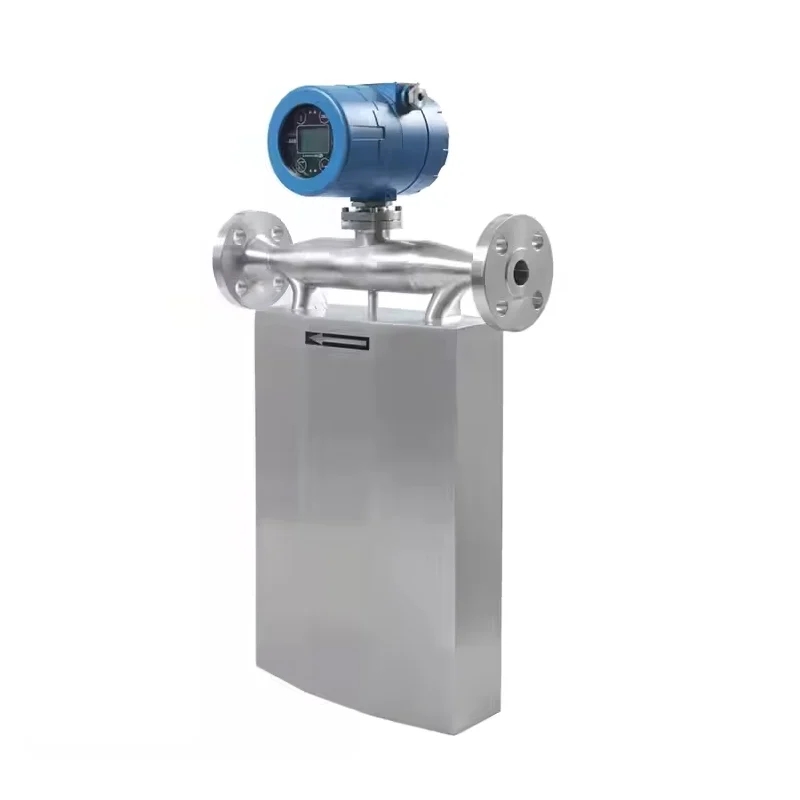
Coriolis
AM-CMFM Coriolis Mass Flow Meter
Coriolis mass flow meter that reads mass, density and temperature from one tube — DN1–DN150, for dosing and recipe lines.
- Model
- AM-CMFM
- Category
- Coriolis
- Outputs
- 4–20 mA, Pulse, RS485, HART
- Lead time
- 7–10 working days for standard
- MOQ
-
1 pc
10 pcs for OEM - OEM available
- Yes
Mass is what a recipe asks for, and a Coriolis meter is the one flowmeter that weighs the medium as it passes: the tube is vibrated, and the phase shift between its inlet and outlet reads mass flow directly. Volume, density and temperature come out of the same measurement, so a batch line needs no second densimeter and no compensating arithmetic.
What that costs is a tube in the line. Nothing moves inside it — no rotor, no orifice, no probe — but the tube is a restriction, the line pressure has to stay inside the size band’s rating, and a medium lighter than 0.2 g/cm³ is outside what the datasheet covers. Sizing it for the flow you run most of the time, not the maximum you might run, is what keeps the zero-point term in the accuracy formula from dominating the reading.
Technical specifications
| Measuring principle | Coriolis: the tube is vibrated and the phase shift reads mass flow; no moving parts |
|---|---|
| What one meter reads | Mass flow, volumetric flow, density and temperature |
| Line size | DN1–DN150 |
| Mass flow range | 0–0.04 t/h to 0–550 t/h depending on tube size |
| Accuracy | ±[0.2 % + zero-point stability ÷ flow × 100 %] of reading |
| Density accuracy | ±0.002 g/cm³ |
| Temperature accuracy | ±1 °C |
| Medium density range | 0.2–3.5 g/cm³ |
| Medium temperature | −40 to +200 °C |
| Maximum line pressure | 30.0 MPa on the smallest tubes, then 4.0 MPa and 2.5 MPa as the size grows to DN150 |
| Ambient | 0 to +40 °C, ≤90 % RH non-condensing, 86–106 kPa |
| Wetted parts | Stainless steel |
| Output | 4–20 mA, frequency/pulse 0–10 kHz, batch relay 24 V / 0.1 A |
| Communication | RS485 Modbus, HART |
| Power supply | AC 220 V ±10 % 50 Hz or DC 24 V ±10 %, under 15 W |
| Hazardous area | Ex ib [ib] IIB T4 intrinsically safe, or Ex d ib [ib] IIB T4 combined |
| Installation | No straight-run or flow-conditioning requirement: the meter measures mass directly |
Every value above is on the datasheet: AM-CMFM Coriolis Mass Flow Meter Datasheet (PDF · 178.1 KB)
What it is not the answer for
Read this before asking for a price: one of these conditions is what turns a good meter into a bad installation.
- Media lighter than 0.2 g/cm³ — light solvents and gases — fall outside the datasheet's density range and the tube cannot be driven to a stable reading
- Ambient above 40 °C or condensing humidity: the electronics' window is 0 to +40 °C at ≤90 % RH, non-condensing
- Line pressure above the size band's rating: 30.0 MPa, 4.0 MPa or 2.5 MPa depending on the tube
- A line where a tube in the flow is unacceptable: a Coriolis meter is a restriction, and on a large line at high flow the pressure drop cannot be paid
- Flows far below full scale: the zero-point term in the accuracy formula then dominates, so the reading is only as good as the sizing
Line pressure beyond the tube rating, or a flow where the pressure drop cannot be paid? Then the Coriolis tube is the wrong principle — the electromagnetic or the clamp-on ultrasonic meter reads the same line without sitting in it.
Maintenance and service life
No moving parts, but not maintenance-free. The vibrating tube sets the zero, and any deposit changes its frequency, so a coating shifts the reading long before anything fails. Verify the zero with the line full and the flow stopped, clean the tube on the interval your medium demands, and recalibrate when the zero no longer holds. The datasheet gives no fixed service interval: it follows the medium, and the verification interval your process has to meet is written into the supply.
Behind the instrument
How it is built and tested
Coil winding, the calibration bench, the plant floor — and an overseas customer's factory audit.
What buyers ask before ordering
- What does a Coriolis meter give me that an electromagnetic one does not?
- Mass, density and temperature from one device. An electromagnetic meter reads volume and needs a conductive liquid; if your recipe is in kilograms, or the density moves with temperature or concentration, the Coriolis tube measures what you actually sell or buy.
- How accurate is it really? The datasheet gives a formula, not a number.
- ±[0.2 % + zero-point stability ÷ flow × 100 %]. The second term is why the meter has a working range: at a fifth of full scale the zero term dominates. Size the tube for the flow you run most of the time, not for the maximum you might run.
- Does it need straight pipe?
- No. The datasheet states no straight-run or flow-conditioning requirement, which is one of the reasons it fits dosing skids and packed layouts where five diameters of clear pipe do not exist.
- What line pressure can it take?
- Rated by size band: 30.0 MPa on the smallest tubes, then 4.0 MPa and 2.5 MPa as the size grows to DN150. Give us the size and the pressure together and we quote the band that holds.
- Which medium is out of range?
- Density below 0.2 g/cm³ — light solvents and gases — and an ambient above 40 °C or condensing humidity. Both are datasheet limits rather than preferences, so say the density and the room when you enquire.
- Can it go in a hazardous area?
- Ex ib [ib] IIB T4 intrinsically safe, or Ex d ib [ib] IIB T4 as the combined version. The datasheet gives the marking without the certificate number — tell us the zone and we send the certificate with the quotation.
- What do you need from me to quote?
- Medium and its density, line size, the flow you run most of the time and the maximum, line pressure and temperature, and which outputs your control system reads. The form on this page asks for exactly that.
Still not sure which version fits your line? Send the medium and the process conditions — we answer with the configuration, not a catalogue.
Applications
Where this model is used
Each application names a measuring point and the conditions that decide the selection.
Elsewhere in the range
Other models in Flow Measurement
The same category holds the models that solve the neighbouring problem, and the price difference is usually smaller than the cost of the wrong principle.
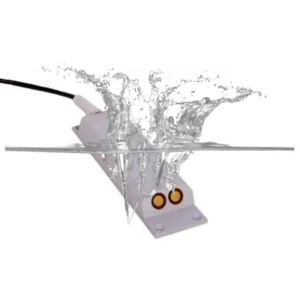
AM-D-DFM
AM-D-DFM Doppler Flow Sensor
RS485 Doppler flow sensor, not a meter: 0.03–5 m/s velocity, 0.05–10 m level, 7.2–15 V DC, for a host to compute flow.
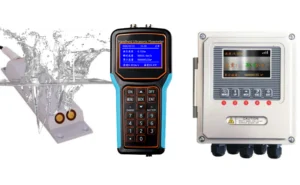
AM-DFM
AM-DFM Doppler Flow Meter
Doppler flow meter for channels, manholes and partly filled pipes: surface velocity plus water level, no weir or flume required.
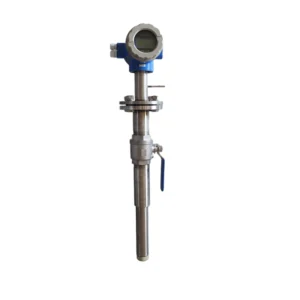
AM-IMFM
AM-IMFM Insertion Type Electromagnetic Flow Meter
Insertion electromagnetic flow meter for existing large mains, DN300–DN3000 — fitted through a 2-inch ball valve, no pipe cut-out.
Measuring point does not match the table above?
Send the medium, the pipe size and the output your control system expects. We answer with the principle that fits, or with the reason none of ours does.