
Doppler
AM-DFM Doppler Flow Meter
Doppler flow meter for channels, manholes and partly filled pipes: surface velocity plus water level, no weir or flume required.
- Model
- AM-DFM
- Category
- Doppler
- Outputs
- 4–20 mA, RS485, Modbus RTU
- Lead time
- 7–10 working days for standard
- MOQ
-
1 pc
10 pcs for OEM - OEM available
- Yes
Not every flow arrives in a full pipe. A Doppler meter measures the velocity at the surface of a channel, a partly filled pipe or a manhole invert, and reads the water level at the same time, so velocity times cross-section gives a flow rate without a weir, a flume or a spool piece to cut in.
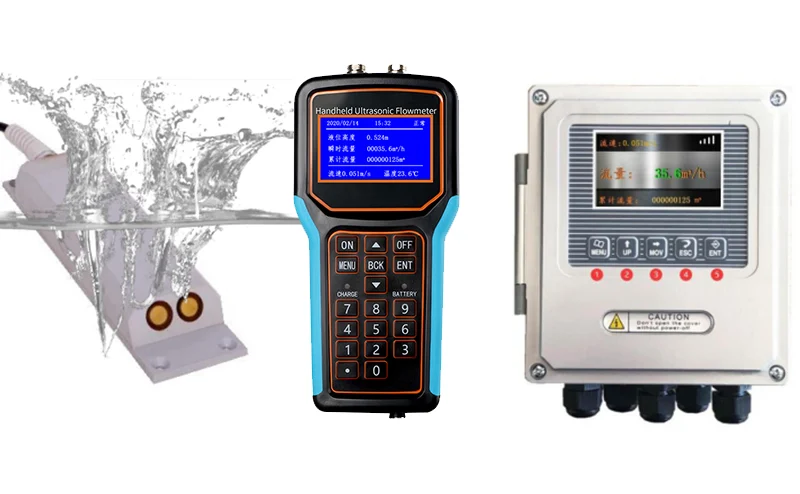
What it needs is something in the water for the pulse to reflect from, a bottom that stays put, and enough depth to work in. The datasheet lists two builds — a wall-mounted unit with 4–20 mA, Modbus and up to four relays, and a portable one with its own battery and no outputs at all — and that difference decides the job more often than the model name does.
Technical specifications
| Measuring principle | Doppler frequency shift for velocity, plus water level and temperature channels — for channels and partially filled pipes |
|---|---|
| Velocity range | 0.03–5.00 m/s, other ranges on request |
| Water level range | 0.05–10 m |
| Water temperature range | −10 to +60 °C |
| Velocity accuracy | ±1.0 % ±1 cm/s |
| Level accuracy | ±0.5 % ±0.5 cm; temperature ±1 °C |
| Ambient temperature | 0 to +60 °C |
| Protection | Transmitter IP65, sensor IP68 |
| Display | TFT colour screen |
| Builds | AM-DFM-W wall mounted; AM-DFM-P portable with battery, no analogue or relay outputs |
| Output | Wall mounted: 4–20 mA, RS485 Modbus, up to four relays (optional). Portable: none |
| Power supply | DC 24 V |
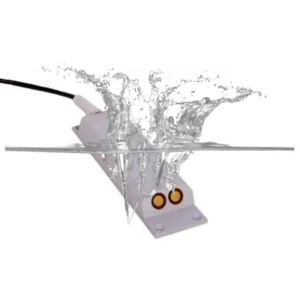
| Installation | Sensor on the channel floor about 5 cm above it, at least 15 cm of water (20 cm preferred), no gate or weir close upstream |
| Air tube | The sensor cable carries an air tube that must stay open to atmosphere and unkinked, or the level reading is wrong |
Every value above is on the datasheet: AM-DFM Doppler Flowmeter User Manual (PDF · 379.1 KB)
What it is not the answer for
Read this before asking for a price: one of these conditions is what turns a good meter into a bad installation.
- Less than 15 cm of water: the sensor's manual puts the floor there, so shallow channels read badly or not at all
- A gate, weir or other obstruction immediately upstream, which leaves the approach unsteady where the sensor sits
- Clear water with no suspended solids or bubbles — there is nothing for the pulse to reflect from. The datasheet lists clear and turbid water both as acceptable, so tell us the solids content and we will confirm which principle applies
- A sensor left in direct sun all day: the probe's own limit is 60 °C, and a sun-baked mounting passes it
- Custody transfer or billing accuracy: ±1.0 % ±1 cm/s is a survey-grade number
- A pressurised full pipe: this reads a free surface, so a full pipe needs the electromagnetic or clamp-on ultrasonic meter
A full pipe, or a liquid with nothing in it for the pulse to reflect from? Then Doppler is the wrong principle — the electromagnetic meter reads a full pipe of conductive liquid, and the clamp-on ultrasonic meter reads a full pipe of almost anything.
Maintenance and service life
The transducer window is the part that fails: silt, algae and rags coat it and the signal fades, so the cleaning interval is set by the water, not the calendar. Check the air tube at the same time, keep the sensor out of standing silt, and on the portable build keep the battery charged between campaigns. The sensor has no moving parts to replace.
Behind the instrument
How it is built and tested
Coil winding, the calibration bench, the plant floor — and an overseas customer's factory audit.
What buyers ask before ordering
- Can it measure in a pipe, or only in an open channel?
- In a partly filled pipe, a channel, a manhole invert or an outfall. It measures the surface velocity and the water level, and the converter multiplies them; a pressurised full pipe is not what it is for, and the electromagnetic or clamp-on meter covers that.
- How much water does it need?
- The sensor's manual puts the minimum at 15 cm of water, with 20 cm or more preferred; the datasheet's level range starts at 0.05 m. Fit the sensor about 5 cm above the channel floor so silt passes under it rather than over it.
- Do I need a weir or a flume?
- No. Unlike an open-channel ultrasonic meter, which converts level to flow through a weir or a flume, this one measures velocity directly and needs neither. What it does need is a straight, stable approach: no gate or weir immediately upstream.
- Wall mounted or portable?
- Both, and the outputs differ: the wall-mounted AM-DFM-W gives 4–20 mA, RS485 Modbus and up to four relays, while the portable AM-DFM-P runs on its own battery and has neither analogue nor relay outputs. Choose the build before the model code is written.
- What is the air tube in the sensor cable?
- The sensor cable carries an air tube that has to stay open to atmosphere and must not be kinked or pulled. It is the reference for the level channel, so a pinched tube shows up as a wrong depth and therefore a wrong flow.
- What do you need from me to quote?
- Channel or pipe size and shape, the medium and its solids content, the depth range you expect, the velocity range, whether the site has mains power, and which outputs the receiving system reads. The form on this page asks for exactly that.
Still not sure which version fits your line? Send the medium and the process conditions — we answer with the configuration, not a catalogue.
Applications
Where this model is used
Each application names a measuring point and the conditions that decide the selection.
WW-OC
Open Channel and Outfall Discharge
Discharge and outfall flow for permit reporting, including channels that were never built to a standard drawing.
WW-FL
Municipal Wastewater Inlet Flow Measurement
Inlet and outlet flow in raw sewage, where solids, gas entrainment and short straight runs defeat clean-liquid meters.
WW-SL
Sludge Transfer and Blanket Level
Sludge transfer flow and blanket level in settling tanks, where coating and low velocity defeat clean-liquid instruments.
Elsewhere in the range
Other models in Doppler
The same category holds the models that solve the neighbouring problem, and the price difference is usually smaller than the cost of the wrong principle.
Measuring point does not match the table above?
Send the medium, the pipe size and the output your control system expects. We answer with the principle that fits, or with the reason none of ours does.